Roasted Squash Soup – Three Ways

The basic technique for this soup can be used with a wide range of winter squash and can take on a variety of different personalities depending on the spices you want to use. Roasting the squash, rather than cubing it and cooking it in the broth, concentrates the flavor, improves the texture and, maybe best of all, avoids the annoyance of having to peel the squash.

I give the basic recipe here using 1 medium kabocha squash and 1 medium butternut because that was what was in our CSA share this week.  You can, however, use all kabocha (1 large or 2 smallish to medium), all butternut (2 large or 3 medium), or even acorn or buttercup (3 medium).

INGREDIENTS:

1 medium kabocha squash

1 medium butternut squash

2 T. olive oil plus more for brushing the roasting pan

1 medium yellow onion, diced

2 cloves of garlic, minced

1 quart low salt chicken stock (preferably very low sodium, if not reduce the added salt)

1½ t. kosher salt

fresh ground black pepper

up to 2 T. of honey if the squash is not sufficiently sweet to your taste

hulled pumpkin seeds for serving (if you can’t find hulled pumpkin seeds you can substitute hulled sunflower seeds, crispy crouton or skip the garnish altogether)

For curried squash soup:  ½” piece of ginger, very finely minced or grated; ½  t. vindaloo spice mix (or ⅛ t. cayenne); and 2 t. garam masala (increase 2½ t. if using cayenne in place of vindaloo), ½ t. cumin, ¼ cup plain greek yogurt

For creamy squash soup:  1 t. ginger, very finely minced or grated; ¼ t. grated nutmeg;  3-4 T. half-and-half (whole milk or light or heavy cream can be substituted they will just affect the richness); and substitute butter for the 2 T. of olive oil and vegetable oil of any kind for the olive oil for the roasting pan.

For New England squash soup:  1 Granny Smith (or other tart) apple; 6-8 fresh sage leaves, finely chopped; substitute butter for the 2 T. of olive oil and vegetable oil for the oil for the roasting pan

PREPARATION:

  1. Preheat the oven to 400 degrees F.
  2. Line a large rimmed baking sheet with aluminum foil.
  3. Cut each of the squash in half and remove the seeds.  Lightly oil the cut side of the squash and the aluminum foil.
  4. Bake the squash cut side down for 30-45 minutes (depending on its thickness) until a knife easily pierces the flesh.
  5. Remove from the oven and allow to cool until it can be handled.
  6. Scoop the flesh from the squash into a bowl and set aside.
  7. In a pot heat the 2 T. olive oil (or butter) over medium low heat.  Add the diced onions (and the apples, if using) and sauté until the onion is almost translucent.  Add the minced garlic (and the ginger, if using).  When the garlic is fragrant add the vindaloo, garam masala, and cumin OR nutmeg OR sage leaves and saute, stirring constantly, for a few seconds.  Add the salt and pepper.
  8. Add the chicken stock and cooked squash flesh and increase the heat to medium-high to bring to a simmer.  Reduce heat and simmer for 15 minutes or so to fully combine the flavors.  Remove from the heat.
  9. Carefully puree the soup in a blender (remove the clear plug in the top and cover with a paper towel to prevent blowing the top off) or with a stick blender.
  10. Return the soup to the pot and check for both sweetness (adding honey if needed), and salt and pepper.
  11. Reheat the soup to just below simmering and add the yogurt or half-and-half stirring to combine.  Do not boil after the dairy is added.
  12. Serve topping with garnish of hulled pumpkin seeds.
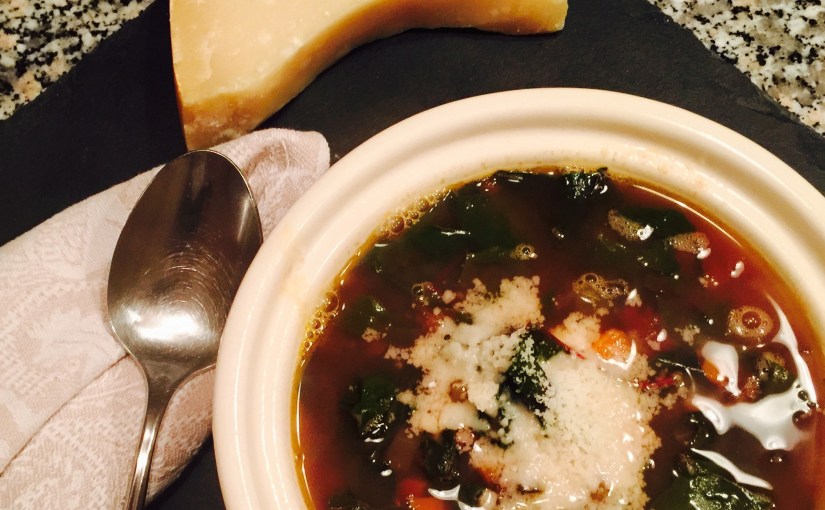
Lentil and Chard Soup

This is a hearty but healthy soup that you can make in just about an hour (and a lot of that time is just letting the soup simmer).  A really good dish for cold fall and winter nights.

This makes four hearty servings.

INGREDIENTS:

2 T. olive oil

1 small red onion (you can substitute yellow onion), diced

1 bunch swiss chard, preferably red (but that’s just for the color)

1 medium carrot, cut into ¼” dice

2 large or 3 small cloves of garlic, minced

2 sprigs of fresh thyme or 1 t. dried thyme

⅔ cup french green lentils (can substitute black lentils or even regular lentils, but the soup will be muddier)

5 cups of low-sodium chicken stock or water

½ t. red pepper flakes (also called crushed red pepper, can substitute hot sauce if needed)

salt and pepper, to taste

4 T. grated parmagian reggiano (or other hard cheese that you like)

PREPARATION:

  1. Heat the olive oil in a large stock pot over medium-low heat.  Add the diced onion and cook for a minute or two, then add the carrot.  Cook the two together until the onion is translucent (about 5 minutes more).
  2. While the onion is cooking, cut the stems from the bottom of the chard leaves.  Trim off the end and cut about half of them (depending on thickness) into 1/4″ thick half moon slices (like you would slice celery).  There should be a little more of the chard stems than of the carrot. Rinse the cut pieces to remove and grit and add the sliced chard stems and the minced garlic to the pot and sauté for a minute or two.  Season with red pepper flakes and salt and pepper to taste (it will definitely need salt).
  3. While the chard is sautéing, rinse the lentils and remove any stones.
  4. Add the lentils and the 5 cups of stock or water to the pot and increase heat to medium high to bring the soup to a gentle boil.  Reduce heat and simmer covered until the lentils are cooked (15 to 30 minutes depending on the type of lentils).
  5. While the soup is simmering, remove the chard leaves from the stem rib that runs up the middle, roll 3 or 4 leaves together cigar fashion and slice across to create a big chiffonade.  When all the chard has been sliced, wash in a salad spinner or in a bowl with several changes of cold water and drain.
  6. Increase the heat to bring the soup back to a boil
  7. Add the chard and cook for 5 minutes or so until it has wilted and been incorporated into the soup.
  8. Adjust salt and pepper to taste and top each bowl with 1 T. of grated parmagian.

Bok Choy and Shiitake Mushrooms with Miso Mirin Glaze

This is a super quick and easy recipe (great for a weeknight and, Sarah, you can leave out the mushrooms if you like or replace them with sautéed red pepper strips) and you can play with the proportions in the glaze until you are happy with the texture and flavor.

This recipe serves 2 generously or 3 as a smaller side dish. It can be doubled easily.

INGREDIENTS:

2 small or one large head of bok choy (you can use baby bok choy but will need to increase the number of heads to at least 3)

4-6 shiitake mushroom caps, cut into 4 to 6 slices each

4 t. canola oil

2 heaping T. of white miso (you can substitute red if you want a funkier flavor)

1 1/2 to 2 T. mirin

1/4 cup very low sodium chicken or vegetable stock or dry white wine or water

PREPARATION:

  1. Bring a small pan or tea kettle of water to a boil.
  2. Cut the bottom from the bok choy to release the individual leaves.  If using one large head, trim the bottom inch or so from the thick stem of any very big leaves.  Wash the bok choy to remove any sand or grit.
  3. Place the bok choy in a heatproof bowl or pan and pour the boiling water over it to wilt it.  In a minute or so drain the bok choy, rinse under cold water to stop any cooking, dry and set aside.
  4. Cut the stems from the shiitake mushrooms and discard (or you can save them in the freezer to add to  a vegetable stock).  Wipe the caps clean and slice them.
  5. Place 2 t. canola oil in a fry pan and place over medium heat.  When hot add the mushroom slices and sauté until they have given up any liquid and are just beginning to brown on the edges.
  6. Remove the mushrooms from the fry pan and the fry pan from the heat (but reserve for final reheating of the dish). Wipe the fry pan with a paper towel to remove any remaining mushroom bits (being careful not to burn yourself.)
  7. In a small sauce pan, add the miso, mirin, and stock/wine or water.   Stir to combine, add black pepper to taste (the miso will have plenty of salt)
  8. Place the sauce pan over medium heat and bring to a simmer.  Simmer until it reaches the thickness of a glaze-so that it will stick to the vegetables.   (You can add more liquid if it gets too thick, or simmer a little longer if it seems too thin).  When done, remove from heat.
  9. Add the last 2 t. of canola oil to the fry pan and place over medium heat.  Quickly add the bok choy and mushrooms and stir fry just to heat through.  Turn off the heat and add enough of the miso mirin glaze to coat the bok choy and mushrooms.  Reserve any extra glaze to serve on the side with the dish.

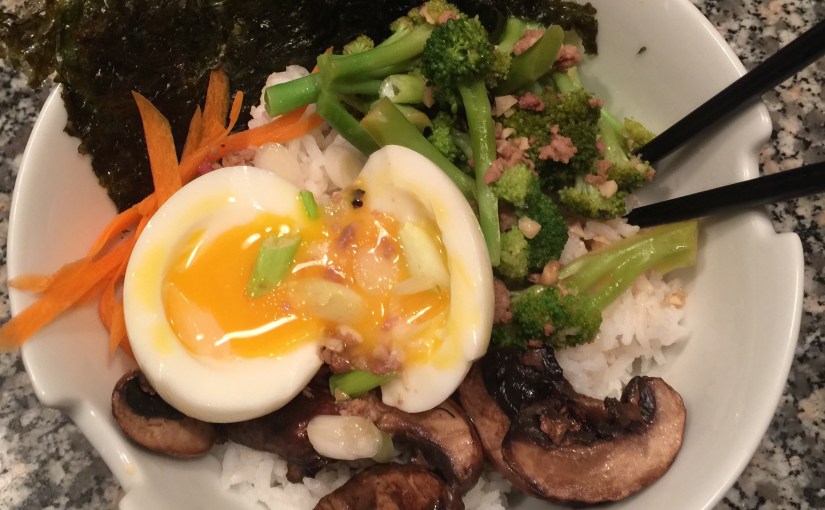
Broccoli, Mushroom and Egg Rice Bowl

This is a simple rice bowl that is easy to make for a weeknight supper.  You can substitute many other veggies for the broccoli and mushrooms according to your taste and whim.  It is also a great way to use up leftover veggies or eats that are already cooked.

This version used a sauce that included a small amount of leftover cooked hamburg, but the meat is not necessary and could be skipped altogether ir swapped out for a very small amount of any protein you like.

Makes generous serving for 2 (with some leftover)

INGREDIENTS:

2 extra large eggs

1 cup long-grain white rice with 2 cups of water for looking

1 small carrot, peeled and then, using the peeler, cut into thin strips

2 small or 1 large scallion, white and light green part, cut into 1/2″ pieces on the diagonal

2 cups broccoli florets , washed and trimmed

6-10 shiitake mushrooms (or cremini if you don;t have shiitake)

1 1/2 t. canola oil

1 t. mirin

1 T. plus 1/2 t. soy sauce (preferably Kikkoman) plus additional for serving

1/2 t. finely minced ginger

1 1/2 t. finely minced garlic (about 2 cloves)

1 cup low-sodium chicken stock

1/3 cup cooked and chopped hamburger or other protein (optional)

2 t. cornstarch

1 1/2 T. cool water

1 t. rice wine vinegar

pinch of sugar or small drizzle of honey

1 piece of sushi nori (optional)

PREPARATION:

  1. Make the rice either by combining rice and water in a rice cooker or by cooking on the stovetop.  Keep covered to stay warm, while making the rest of the meal.
  2. Bring a pan of water to a low boil over medium heat.  Prepare a bowl with cold water and ice to cool the eggs.
  3. Add the eggs to the boiling water and adjust heat to maintain a simmer for exactly 6 1/2 minutes. (A good way to do this is to set a timer for 7 minutes and add the eggs to the water when the first 30 seconds has elapsed.)
  4. Immediately remove the eggs with a slotted spoon and place in the ice water bath to fully cool.
  5. Peel the carrot into thin strips and slice the scallions.  Set aside.
  6. In a fry pan over medium heat, put 1/2 t. of the  canola oil, the mirin and 1/2 t. of the soy sauce.
  7. Add the mushrooms and sauté until they are cooked through and their juices have reduced to a thickish (but still moist) coating on the bottom of the pan.  Transfer to a bowl, cover and set aside.
  8. To the fry pan, add 1 t. canola oil, the minced ginger, and garlic and sauté briefly.
  9. Add the chicken stock and 1 T. of soy sauce and cook until just reaching a boil.
  10. In a small bowl or measuring cup, mix the cornstarch and water.
  11. Pour this slurry into the chicken stock mixture and whisk until smooth and thickened.
  12. Add the rice wine vinegar and the pinch of sugar/honey.  Add the cooked meat, if using.  Set aside.
  13. Place water in the bottom of a steamer and the broccoli florets on top (alternatively, you can microwave the florets in a bowl with a small amount of water and a lid) and cook until just crisp-tender.
  14. Reheat the sauce briefly if needed.
  15. Drain and VERY gently peel the eggs and set in a bowl.
  16. Add a serving of rice to the bottom of a bowl.  Top with mushrooms, carrots, scallions, and broccoli.
  17. Gently hold an egg in the palm of your hand and use a knife to split it almost all the way in two keeping the halved pressed together (and not slicing your hand).  Open the egg over the rice bowl and nestle it on top.
  18. Drizzle several tablespoons of the sauce over the top of the egg and broccoli and garnish with the nori sheet, if using.
  19. Serve with additional soy sauce on the side.

Caramelized Apples

This is very much like apple pie filling without the crust.  It is good served warm or cold and as everything from fruit with breakfast to a side dish for roasted meats to the sauce under a scoop of vanilla ice cream.

Makes 4 servings

INGREDIENTS:

4 medium to large apples (Honeycrisp hold their shape really well and are not too sweet, but Cortland and Braeburn work as well) peeled, cored and cut into 1/4″ thick slices

2T unsalted butter

2T dark brown sugar

pinch of salt

1/4 t. cinnamon (or more to taste)

pinch of nutmeg (optional)

PREPARATION:

  1.  In a pan with a thick bottom and a cover, heat the butter until just melted.
  2. Stir in the brown sugar until melted.
  3. Add the apple slices (the caramel will seize up as the apples are added but will relax as they cook).  Cover and cook for 5 to 8 minutes depending on the size and type of apples) until soft but not mushy.
  4. Add the salt, cinnamon and nutmeg if using and stir gently.
  5. Remove from heat and serve or cool to room temperature.  Can be refrigerated for several days.

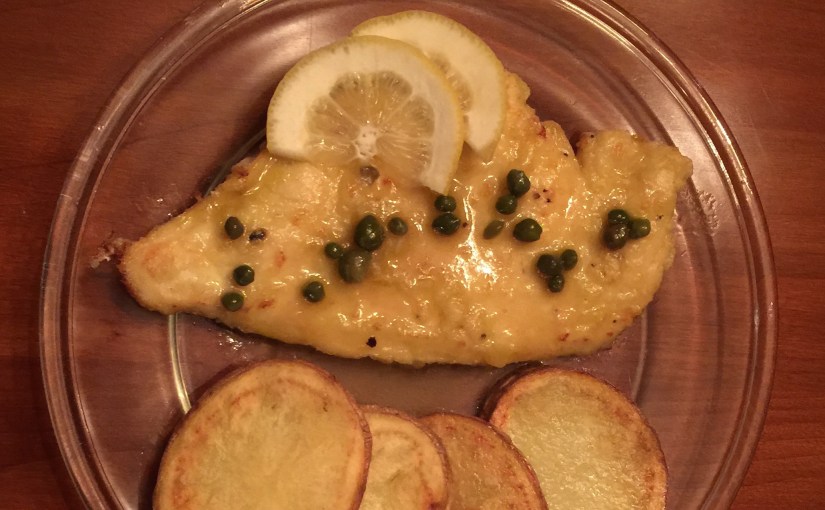
Crispy Lemon Chicken

This is a quick and lighter version of Chicken Piccata.  It can be served with pasta, rice, potatoes or just with an assortment of roasted or steamed vegetables.  This recipe is meant for two but it can easily be doubled (although if you want it all done at once you will need more than one frying pan).  It has been a favorite in our house for a very long time.

INGREDIENTS:

1/2 cup all purpose flour

2 T. white rice flour (optional, but it makes the cutlets crispier)

1 t. kosher salt

liberal grinding of fresh black pepper

2/3 to 3/4 lb. thin-sliced chicken breast (you can buy it this way or slice across a breast and place in a plastic bag with a few drops of water and pound until thin)

3/4 cup milk (preferably whole milk, but any kind will work)

1 lemon

3 T. olive oil

1/4 cup low-sodium chicken stock

1 -2 t. capers. drained

PREPARATION:

  1. If you are working with whole chicken breast, slice it across into 2 pieces per breast.  Place in a  gallon sized plastic bag and sprinkle in a little water.  Close the bag and pound the chicken until it is about 1/4″ thick.
  2. In a container large enough to hold one piece of the chicken lying flat, pour the milk.  Add the chicken stacking one piece on top of each other and place in the refrigerator to soak for at least 10 minutes but up to a few hours.
  3. Mix the flour, rice flour (if using), kosher salt and black pepper together in a shallow bowl or pan large enough to hold most of one piece of the chicken.
  4. Wash the lemon and cut a few thin slices from one end (for garnish so you will need at least one slice per piece of chicken). Set the slices aside until the dish is done.
  5. Squeeze the juice from the remaining lemon (you should have 1 1/2 to 2 T.) and set aside.
  6. Put the olive oil into a large fry pan and bring to medium heat.
  7. Take the chicken piece out of the milk and dredge in the flour, gently shaking off any excess.  Place each chicken piece carefully into the hot oil.  Cook for a few minutes on the first side until the flour has browned and is nicely golden.  Carefully turn the chicken and cook of a minute or two on the second side.
  8. Remove the chicken pieces to a warm plate.
  9. Increase the heat under the fry pan to medium high and add the chicken stock to the oil left in the pan, stirring to incorporate any bits of the coating left on the bottom of the pan.  Add the lemon juice and boil until the sauce is slightly thickened. Turn off the heat and add the capers to warm through. Check the seasoning and add salt and pepper to taste.
  10. Place one or two chicken cutlets on each plate and top with the sauce as well as a slice of lemon.

Spaghetti and Meatballs

This is really a recipe for meatballs as it can be used with any good homemade tomato sauce or (if really pushed) a jar of Rao’s sauce of your choosing.  I know that Rao’s is expensive, but it is the only one I have found so far that doesn’t contain copious amounts of sugar.  That said, any homemade tomato sauce (even one that starts with canned or boxed tomatoes) will beat a jar any time.  The key to moist and light meatballs  is ….. water.  I don’t remember any more what food writer noted that water works better than most other liquids, but my experience says that he or she was right!  I use the same recipe for meatloaf and have included a note at the end of the Preparation section about the assembly and cooking time for meatloaf.

Notes:  The meatball recipe makes at least twice as many meatballs as you will need for four to six people.  Freeze the other half and you will have either meatballs for the future or a meatloaf.  The meatballs can be cooked right in the sauce but they do add fat to it (good or bad depending on your point of view) along with flavor.  If you prefer, they can be pre-baked in a 350 degree oven until some of the fat has been rendered and they are browned and partially cooked and then added to the sauce.

This recipe serves 4-6 depending on portion size

INGREDIENTS:

2 T. olive oil

1 large yellow onion, chopped  AND

1 small yellow onion, minced (chopped very finely)

6 cloves of garlic, minced

1 green pepper, finely chopped

2 boxes (26.45 oz.) San Marzano crushed tomatoes

2 t. dried basil

1 t. dried thyme (or oregano if you prefer)

1 lb. 90% lean ground beef or ground sirloin

1/2 lb. ground pork

1/2 lb. ground veal (or ground turkey if you can’t find/prefer not to use veal)

1 egg, beaten slightly

1 T. lemon juice

1/2 cup of Panko bread crumbs

1/4 to 1/3 cup of finely grated parmigiano (optional, but it improves both flavor and texture)

1 cup of cool/cold water

salt

freshly ground black pepper

1 lb. dried spaghetti or thin linguini

PREPARATION:

  1.  In a pot large enough to accommodate the sauce and half of the meatballs, heat 2 T. of olivel oil over medium heat and add the large chopped yellow onion.  Sauté until translucent.
  2. Add half of the minced garlic cloves and the green pepper to the onion and sauté for 1-2 minutes.
  3. Add the crushed tomatoes, basil and thyme and stir to combine.  (if you happen to have an open bottle of a decent red wine you can also add a glug of it at this point, but that is strictly if it happens to be on hand)
  4. Bring the sauce to a simmer and partially cover with pot lid.  Simmer until sauce changes from bright to  a deep red color and the flavors have combined nicely.  Add salt and pepper to taste.
  5. While the sauce is simmering, make the meatballs.
  6. In a large bowl, place the small minced onion, the remaining minced cloves of garlic, the beef, pork, veal/turkey, the beaten egg, lemon juice, breadcrumbs and parmigiano (if using).  Add 1/2 cup of water and mix gently just to combine.  If the mixture feels dense add water 1/8 cup at a time, until it begins to feel noticeably lighter.  At that point stop mixing.
  7. If the sauce is not yet ready, refrigerate meatball mixture until ready to use.  You can also divide it in two at this point and freeze half for later use.
  8. With sauce still at a simmer, use your hands and half of the meatball mixture to make meatballs that are 1 1/4 to 1 1/2 inches in diameter and add to sauce to cook.  Simmer for 15 to 20 minutes and cover leaving on stove to stay warm.
  9. While the sauce and meatballs are simmering, bring a large pot of salted water to a boil.
  10. When the meatballs are done, add the pasta to the salted water and cook for the time directed on the package.  Drain the pasta, reserving 1/2 cup of the pasta cooking water.
  11. Serve the pasta and top with meatballs and sauce, along with more of the parmigiano.  Note:  If the sauce has become a bit too thick while on the stove, you can add a little of the pasta cooking water to thin it a bit.

MEATLOAF VARIATION:

You can take half of the meatball mixture and shape it into a freeform meatloaf.  Make certain that the pan in which you cook it is big enough to leave room on all sides (so the excess fat can be released).  You can place it on a rack in the pan if you want the fat to fully drain.  For the meatloaf to remain moist it needs some kind of covering.  A few bacon strips are the material of choice for me but, if you don’t want to add more fat the the meatloaf, you can also mix ketchup and brown sugar or use barbecue sauce to insulate the meatloaf.  Cook in a preheated 350 degree oven for 45 to 65 minutes depending on the shape of your meatloaf.  Allow to rest for 10 to 15 minutes covered with foil before serving.

Oven Roasted Tomatoes

These are one of the most versatile things I keep in the freezer.  They can be chopped up for a quick tomato sauce over pasta (see earlier recipe for ravioli), put onto a homemade pizza, or added to a salad.  A few chopped and added to sautéed vegetables truly “elevates” the dish (as the fancy cooks say) and they can even be tucked into a sandwich.  They take a few hours to make, but it is mostly hands off so–as long as you plan to be at home–you can do something else while a pan of tomatoes transforms into something truly heavenly.

Make sure you keep the oil in the pan with the tomatoes–Sarah and Kate used to fight over who got to wipe up the excess with a piece of crusty bread.

This recipe can be increased exponentially depending on your oven size and patience.  It is my adaptation of one that appeared years ago in Saveur.

INGREDIENTS:

5 lbs. of the freshest, tastiest tomatoes you can find (they don’t have to be pretty and this will transform even somewhat lackluster tomatoes, but the better they start out, the better the result)

3-4 garlic cloves, peeled and sliced into 4-5 slices each

dried herbs of your choosing (basil and thyme are among my favorites, but this ingredient is up to you and optional)

2 t. salt

1 t. fresh ground pepper

1 – 2 T. sugar

1/4 cup balsamic vinegar

1 cup of good quality olive oil

PREPARATION:

  1. Preheat the oven to 325 degrees F.
  2. Line a large rimmed baking sheet (a half sheet pan works well, if you have one, but anything with a rim will do) with aluminum foil.
  3. Wash the tomatoes, remove the stem if needed, and cut in half across the middle (stem end on one end, bottom on the other).
  4. Pour 1/4 cup of the olive oil onto the baking sheet.  Place the tomato halves into the oil and roll the bottom around to coat.
  5. Distribute the slices of garlic on top of the tomato halves.
  6. Sprinkle the tops of the tomatoes with herbs (if using), salt, pepper, and sugar.
  7. Drizzle the balsamic vinegar over the tomatoes.
  8. Pour the remainder of the olive oil over the tomatoes.
  9. Place in the oven to roast for 2 to 4 hours depending on the size of the individual tomatoes (you can speed this up a bit by raising the temperature of the oven to 375, but then you really have to keep an eye on the tomatoes to make certain that they don’t burn).  At the one hour mark check the tomatoes.  if they are not releasing their juices, press down gently on them with a spatula being careful not to get squirted in the process.  Return to the oven and roast until they look like the picture above.
  10. When they are cool, package in plastic bags or other containers and freeze, keeping the oil with them.  Then sop up the remaining juices with a piece of good bread!

Homemade Ricotta

It is only recently that I found out how ridiculously easy and delicious homemade ricotta cheese is!  Had I known it all these years, many of my dishes–especially pasta ones–would have been made much, much better!

This recipe makes two cups of ricotta and it will last a week or so in the fridge in a tightly closed container.

Three simple pieces of kitchen equipment are helpful: cheese cloth (found in almost any grocery store and required), an instant read thermometer (a real help but you could guess the temp based on bubbles and steam) and a regular mesh strainer.

INGREDIENTS:

1/2 gallon (2 quarts) of whole milk (you can substitute light or even heavy cream for up to 1/2 of the milk to make it much richer, you can also substitute 2% for up to half of the milk to make it lighter, but it will also make it grainer because of the reduced fat)

1/3 of a cup of fresh lemon juice (you can substitute a good white wine vinegar or even a flavored vinegar, as long as it is white in color)

3/4 t. kosher salt

PREPARATION:

  1.  Place the milk in a heavy bottomed pan and heat slowly to 200 degrees F.  This is just below a boil but the milk may have some bubbles.  Store the milk periodically as it heats to prevent a skin from forming (if one does just stir it vigorously back into the milk).
  2. When it reaches 200 degrees, remove from heat and add the lemon juice (or vinegar) and the salt.  Give a quick stir and wait 6-10 minutes until curds have formed and separated from the (now yellow) liquid-this is whey, as in curds and whey.
  3. Line a strainer set over a bowl with cheesecloth (at least two single layers thick).
  4. Pour the curds and whey through the cheesecloth and strainer, draining the whey into the bowl.  Allow to drain for 10 to 45 minutes depending on how dry/dense you want the cheese (you can taste along the way).   Discard the whey.
  5. When it has reached the desired consistency, transfer to a container and, when cooled to room temperature, refrigerate.  That’s it!

Zucchini, Lemon and Ricotta Pasta

This recipe has been adapted from one by David Tanis in the New York Times (and was a hit three weeks ago with Kate, Sarah and Jeff!).  It is better made with homemade ricotta (recipe to be posted next) but works fine as long as you buy a good quality supermarket or specialty store ricotta.  it makes four generous servings.

INGREDIENTS:

5 T. good olive oil

3 garlic cloves, minced

large handful of basil leaves (about 1 cup packed)

1/2 large yellow onion or 1 small onion, diced finely

2 medium zucchini (or more if they are small, try to avoid the ones the size of baseball bats because of their seeds)

1 pound of dried pasta such as penne, ziti or trofie

1 cup of ricotta cheese (or a little but more if, like Sarah, you like everything extra cheesy!)

pinch of red pepper flakes

1 lemon, zested (only zest is needed in this recipe)

1/2 to 3/4 cup of grated parmigian cheese

salt and pepper to taste

PREPARATION:

1.  Heat a large pot of water to a boil adding a good amount (1 -2 t.) of salt to the water.

2.  Meanwhile, wash and cut the zucchini across into thin (1/4″ or so) circular slices and set aside.

3.  In a small food processor or chopper, place the garlic, basil leaves and a large pinch of salt.  Process until a rough paste forms.  Add 3 T. of olive oil and continue processing until combined. Set aside.

3.  In a large fry pan, heat 2 T. of olive oil over medium heat and cook the onion until translucent.  Add the zucchini and salt and pepper to taste and cook until done to your liking (3 to 6 minutes, depending on its texture). Turn off the heat.

4.  Add the pasta to the cooking water and cook until just al dente (check package).  Before draining, remove 1 cup of the pasta cooking water.  Drain the pasta and add to the skillet with the onion and zucchini.  Toss to combine.

5. Add a little of the pasta water to moisten the mixture, then add the ricotta, red pepper, lemon zest.  Turn on the heat to medium again and toss to combine as it cooks just a bit more.  If the mixture isn’t creamy enough add more pasta cooking water until the consistency is just about right.  Turn off the heat.

6.  Add the basil paste and half the parmigian. Mix one last time and check for salt and pepper, adding more if needed.

7.  Serve, passing the remaining parmigiana for topping the dish.